 27 September 2025 ISLAMABAD:
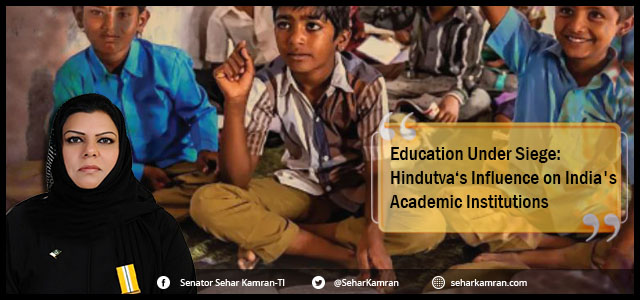
Hindutva’s ideological takeover of India’s schools and universities threatens to obliterate secular education and entrench exclusionary nationalism.
India’s education system has long been commended for its pluralistic, inclusive, and secular values—a system that focused on intellectual thought, rationality, and scientific principles instead of religious bias. Rooted in liberal values, post-independence India’s educational system was deliberately designed to uphold inclusiveness and a diversity-oriented curriculum that transcended religious bias, caste issues, and regional boundaries while promoting unity in diversity. However, a gradual shift has been observed in the country’s education system ever since the Hindu nationalist Bharatiya Janata Party (BJP) came into power in 2014.
This shift can be best understood through the lens of Hindutva, a form of Hindu nationalism which asserts that Hindus have religious and cultural superiority over other minorities in the country, such as Muslims and Christians, thereby aiming to redefine India’s national identity. Originally articulated by Vinayak Damodar Savarkar in the early 20th century, Hindutva envisions India not as a secular republic but as a Hindu rashtra—a nation anchored in the symbols, myths, and history of Hindu civilization. While distinct from the religion of Hinduism itself, Hindutva is a political construct that mobilizes religious identity to serve a nationalist agenda. In recent years, the rise of the BJP and its ideological affiliates has mainstreamed this vision across state institutions, with education emerging as a central battleground.
Ideological and Historical Background
Hindutva is a combination of two words, ‘Hindu’ and the Sanskrit word tattva (‘thatness’ or ‘essence’).1 In 1892, a Bengali writer, Chandranath Basu, first coined the term “Hindutva” in his book titled “Hindutva: Hindur Prakrita Itihas”2 to assign a religious dominance to the Hindus. However, this definition was later popularized as a political ideology by Vinayak Damodar Savarkar, who militarized and propagated the idea of Hindutva as Hindu nationalism. In his book “Essentials of Hindutva” published in 1923, Savarkar defined a Hindu not merely by religion but as someone who regards India as both their fatherland (pitribhumi) and holy land (punyabhumi). He argued for cultural and political unity among Hindus, emphasizing shared ancestry, heritage, and civilization over religious diversity. It promoted the idea of a ‘Hindu rashtra’ (Hindu nation). It excluded Muslims and Christians from this identity if their holy lands lie outside India and laid the groundwork for modern Hindu nationalist thought.
In 1892, a Bengali writer, Chandranath Basu, first coined the term “Hindutva” in his book titled “Hindutva: Hindur Prakrita Itihas ” to assign a religious dominance to the Hindus. However, this definition was later popularized as a political ideology by Vinayak Damodar Savarkar, who militarized and propagated the idea of Hindutva as Hindu nationalism.
This vision was institutionalized with the creation of the Rashtriya Swayamsevak Sangh (RSS) in 1925. The RSS was created as a voluntary paramilitary organization to build a disciplined Hindu nation. It has had a controversial past, having been banned three times post-independence. Its member Nathuram Godse was involved in the murder of Mahatma Gandhi. However, the RSS has developed its own network of affiliates over the years, including the present ruling party, the BJP, and has become a forceful actor in Indian politics today.
Foundation of India’s Education System Post-Independence
After partition in 1947, India’s first Prime Minister Jawarlal Nehru became the chief architect of India’s secular, pluralistic, and intellectual education policy. He believed in removing religious influence from state-run institutions and wanted his countrymen to focus on scientific thought, rationality, and technological development. He laid down this foundation in his book in these words: “A state which honors all faiths equally and gives them equal opportunities; that, as a state, it does not allow itself to be attached to one faith or religion, which then becomes the state religion.”3
Nehru’s vision was further cemented by Maulana Abdul Kalam Azad, India’s first education minister, who played a pivotal role in shaping India’s secular public education system, which aimed to foster critical inquiry, scientific temper, and inclusive narratives that celebrated India’s composite heritage. Institutions were designed to remain autonomous, promoting debate and diversity of thought without aligning with any one religious or ideological framework.
Education has always been viewed as a tool to shape the minds of the future generation according to their own goals and demands. Its significance was understood by Hindu nationalists who believed that they could shape the national consensus through the educational system, which had a sole focus on highlighting and glorifying Hindu cultural dominance over other religions and sidelining minorities or any voices of dissent that might come their way. To establish ideological hegemony, Hindutva aims to restructure the intellectual foundation of the country.
Curriculum Revisions
In the last decade or so, it would not be an exaggeration to say that Indian textbooks have become a battleground for the BJP-led Hindu nationalists. The RSS and the BJP want education as a carrier of their “one nation, one culture, one language” ideology. In their bid to rewrite history and establish Hindu supremacy, the BJP government has undertaken several steps to align the historic and civic values with the contours of Hindutva ideology.
The Indian National Council of Educational Research and Training (NCERT), established in 1961, was an autonomous organization to assist and advise both the Central and State Governments on matters related to school education. NCERT textbooks are prescribed in at least 19 school boards in 14 Indian states. More than 24,000 schools are affiliated with India’s Central Board of Secondary Education (CBSE), with tens of millions of students.4 In 26 countries across the world, CBSE has about 240 affiliated schools where these textbooks are being taught.
Over the last few years, NCERT has started introducing changes in the social sciences and English textbooks. From omitting Darwin’s theory of Evolution in the 2021-2022 academic year to excluding the role and achievements of the Mughals and the Delhi Sultanate5, BJP is on its mission to make a constitutionally secular India with an ethnic Hindu state.
The NCERT political science textbooks for Grades 11 and 12 have removed a reference to the brief ban on RSS after Gandhi’s assassination. The new curriculum has also sidelined the role of Indian Muslim leaders like Maulana Abdul Kalam Azad from the new Class 11 political science textbook, titled ‘Constitution – Why and How?’.
In their quest to revise history, the 2002 Gujarat riots, which were called “anti-Muslim riots” in the NCERT political science textbook for Class XII, are now called just the “Gujarat riots”.6 However, in the same paragraph, the 1984 riots are described as anti-Sikh.
Over the years, they have removed multiple references to the Babri Masjid from the textbooks. So much so that in 2024, the name of Babri Masjid was replaced by the words “three-dome structure” in the Class 12 Political Science textbook.7
Similarly, in Rajasthan, school curricula have seen the glorification of local Hindu kings at the expense of nuanced accounts of Mughal rulers and other Muslim figures. In Uttar Pradesh, textbooks increasingly emphasize Vedic knowledge and Hindu symbols, while reducing space for Islamic and Christian contributions to India’s culture.
BJP and its Hindutva allies have become so emboldened that they have started taking similar measures in Indian Illegally Occupied Jammu and Kashmir (IIOJK) as well. The Hindutva regime has banned 25 books on the pretext that they are propagating “false narratives” about Kashmir, while “playing a critical role in misguiding the youth, glorifying terrorism and inciting violence against the Indian state.”8
The cumulative impact of this systematic omission of Muslims from India’s history is to control national identity and legitimize the Hindutva authority. Deleting chapters or distorting history is a way to reshape collective memory—erasing inconvenient truths, downplaying past injustices, and portraying the dominant group as the rightful and eternal custodian of the nation. This selective storytelling turns history into propaganda, narrowing citizens’ understanding of their heritage. In essence, it is not about the past—it is about owning the future by controlling how people see the past.
Institutional Appointments
Apart from the curriculum manipulation, the Hindutva project wants to exert its influence over India’s academic and research institutions. Since 2014, the key positions in bodies such as the Indian Council of Historical Research (ICHR), the University Grants Commission (UGC), the Indian Council of Social Science Research (ICSSR), and prestigious universities have been filled with individuals known for their ideological alignment with the RSS and its affiliates.
India’s opposition party, Congress, has criticized these moves. Its Secretary General Jairam Ramesh criticized the “systematic” infiltration of the RSS into the professional institutions like ICHR after the BJP came to power in 2014.9
This trend of appointing RSS-inspired individuals has continued in universities such as the Jawaharlal Nehru University (JNU) and Banaras Hindu University (BHU), where vice-chancellors with strong Hindutva leanings have overseen shifts in hiring practices, research funding priorities, and campus regulations that marginalize dissenting or non-aligned voices. The appointed individuals are not even shying away from their association with the extremist RSS organization, as the new Vice Chancellor, Santishree Pandit, said that “while she is proud to be a Hindu and her association with RSS, there is a need to counter the left narrative.”10 Such appointments erode institutional autonomy by subordinating academic governance to political loyalty. Decision-making in faculty recruitment, funding allocations, and research approvals increasingly reflects ideological considerations rather than academic merit. In some cases, scholars critical of Hindutva or working on minority histories have faced obstacles in securing research grants or promotions. At the same time, projects reinforcing a Hindu nationalist narrative receive encouragement and resources.
The result is a narrowing of India’s intellectual space. When leadership positions are occupied by those whose primary allegiance is to an ideology rather than to scholarly rigor, the scope for independent thought diminishes. Over time, this politicization threatens to transform universities and research bodies from spaces of critical inquiry into echo chambers that legitimize and amplify a singular worldview, undermining the pluralistic and secular foundations on which India’s higher education system was built.
Suppression of Dissenting Voices
Since 2014, the crackdown on Indian universities by the Hindutva regime has been a part of its policy to clamp down on dissenting voices, especially by those challenging the Hindutva narrative. A crackdown on students was seen in the case of JNU in 2016. Similarly, Jamia Millia Islamia11, Aligarh Muslim University12, and the University of Hyderabad has become an epicenter of state action against student activism. The tragic case of Rohith Vemula, a Dalit PhD scholar at Hyderabad Central University (HCU) who died by suicide in 2016 after facing institutional discrimination, highlighted the deep structural prejudice against marginalized voices. Protests against government policies—ranging from the Citizenship Amendment Act (CAA) to fee hikes—have often been met with police brutality, campus raids, and arbitrary detentions.
The Indian government is employing all tools in its arsenal, from sedation laws to the Unlawful Activities (Prevention) Act (UAPA), against all dissenting voices, thereby criminalizing peaceful protests. Student leaders like Umar Khalid of JNU have been in jail under UAPA since 2020.13 Leave alone students, even faculty members in Indian universities are not safe anymore and have faced harassment, suspension, or non-renewal of contracts, creating a climate of fear within academic spaces.14
The consequences are profound. Student democracy, once a hallmark of Indian universities, is being eroded. Open political debate has been replaced by surveillance and intimidation. Academic freedom suffers as scholars self-censor to avoid reprisal. The mental health of students, particularly those from vulnerable communities, has deteriorated under sustained harassment and uncertainty. By stifling critical engagement, the state undermines the very purpose of higher education: to nurture free thought, challenge orthodoxy, and cultivate informed citizenship. This suppression risks turning universities into echo chambers of the ruling ideology rather than spaces of independent inquiry.
Impact on Research and Academic Discourse
Hindutva’s growing influence on the educational sphere has unsurprisingly had a negative impact on the country’s research and development environment. Research autonomy is required in the humanities and social sciences, but the present Indian government has steadily been stripping away their independence.15
Government funding increasingly favors science, technology, engineering, and mathematics (STEM) fields aligned with national development rhetoric, while critical disciplines such as history, sociology, and political science face defunding or redirection towards ideologically driven projects. This narrowing of research priorities discourages independent inquiry into politically sensitive subjects, effectively sidelining scholarship that challenges the majoritarian narrative.
In an environment of fear, scholars and faculty start self-censoring themselves to protect themselves from harassment or legal action under sedition and anti-terror laws. Academics are compelled to avoid contentious topics—from caste discrimination to religious violence—that might invite political scrutiny. The chilling effect extends to conferences, publications, and classroom discussions, where language is carefully tempered to avoid perceived ideological offence, mainly against Hindus. The Indian government has even denied giving research visas to foreign scholars who have been critical of the BJP government.
In the long term, this Hindutva-driven academic model will only harm India as its intellectual capacity and critical thinking ability in its society will diminish. It will also undermine the country’s democratic values and its intellectual standing in the comity of nations.
Broader Sociopolitical Implications
To gain control of the academic narrative in educational institutions by the BJP-led Hindutva regime is not an isolated step. It is integral to a larger political agenda of consolidating Hindu Majoritarianism. By reshaping curricula, controlling research priorities, and installing ideologically aligned administrators, the state uses education as a tool to normalize a singular cultural identity rooted in Hindu nationalism. This intellectual re-engineering embeds the Hindutva worldview into young minds, fostering loyalty to a majoritarian vision while marginalizing alternative narratives.
Such a shift deepens the alienation of Muslims, Dalits, and other minority communities. Erasing or distorting their histories in textbooks, excluding their contributions from national narratives, and silencing voices that challenge dominant ideology not only undermine their sense of belonging but also reinforce social hierarchies. Campuses, once spaces of social mobility and diversity, increasingly reflect the exclusionary ethos of the ruling ideology. India’s future is at stake. The erosion of pluralism in education has far-reaching consequences for India’s democratic fabric.
Hindutva ideology has laid siege on India’s educational institutions. Political orthodoxy has replaced intellectual freedom and critical thought. The BJP-led Hindutva regime is employing tactics to revise history by changing the educational curriculum and silencing dissenting voices to control the national narrative and legalize their authority. A narrative is being crafted that glorifies only one religion while sidelining other minorities. Safeguarding the integrity of education demands collective resistance. Scholars, students, and civil society must defend academic freedom, while international academic bodies and human rights organizations must hold India accountable to its constitutional and global commitments.
- Suhag Shukla, “What Does Hindutva Really Mean?” Hindu American Foundation, October 5, 2021, https://www.hinduamerican.org/blog/what-does-hindutva-mean
- Chandranath Basu, Hindur Prakrita Itihas, trans. & ed. (Kolkata: Gurudas Chattopadhaya, 1892), accessed August 5, 2025, Internet Archive, https://archive.org/details/in.ernet.dli.2015.352815Jawaharlal
- Nehru, The Discovery of India (Bombay: The Signet Press, 1946).
- Srishti Jaswal, “Mughals, RSS Evolution: Outrage as India Edits School Textbooks.” Al Jazeera, April 14, 2023.
- https://www.aljazeera.com/news/2023/4/14/mughals-rss-evolution-outrage-as-india-edits-school-textbooks
Ibid. - Ritika Chopra, “In New NCERT Book, Gujarat Anti-Muslim Riots Now Called Gujarat Riots,” Indian Express (New Delhi), March 24, 2018. https://indianexpress.com/article/education/gujarat-anti-muslim-riots-now-gujarat-riots-in-new-ncert-book-5109321/
- “What’s Missing from Your Child’s Textbook? A Deep Dive into NCERT’s Revisions in Modi Years,” Newslaundry, August 4, 2025. https://www.newslaundry.com/2025/08/04/omissions-and-revisions-in-modi-years-how-indias-school-textbooks-are-being-rewritten
- AFP, “25 Books Banned in India-Occupied Kashmir for ‘Propagating Secessionism,’” [News outlet], updated August 7, 2025. https://images.dawn.com/news/1193943/25-books-banned-in-indian-occupied-kashmir-for-propagating-secessionism
- “Jairam Ramesh Alleges ‘Systematic Infiltration’ of RSS into Professional Institutions,” Hindustan Times, updated June 2, 2025. https://www.hindustantimes.com/india-news/jairam-ramesh-alleges-systematic-infiltration-of-rss-into-professional-institutions-101748859648962.html
- Nadeem Inamdar, “Proud to Be Associated with RSS, Need to Counter Leftist Narrative: JNU VC Shantishree Pandit,” Hindustan Times, September 18, 2023. https://www.hindustantimes.com/cities/pune-news/proud-to-be-associated-with-rss-need-to-counter-leftist-narrative-jnu-vc-shantishree-pandit-101694975582697.html
- Apporva Anand, Suspensions, surveillance, and silencing: Understanding the student crackdown at Jamia Millia, Front Line, February 19, 2025. https://frontline.thehindu.com/society/jamia-millia-islamia-university-students-protest-hindu-muslim-oppression-bjp-rss/article69238271.ece
- CAA protests: Tension in some areas around AMU, 26 people released, The Hindu, December 17, 2019. https://www.thehindu.com/news/national/caa-protests-tension-in-some-areas-around-amu-26-people-released/article30330147.ece
- Soutik Biswas and Umang Poddar, “Umar Khalid: Indian Activist Languishes in Jail without Bail or Trial,” BBC News, January 23, 2024. https://www.bbc.com/news/world-asia-india-67980484
- Vedaant Lakhera, At Delhi’s Ambedkar University, control is the curriculum, Front Line, April 14, 2025. https://frontline.thehindu.com/news/ambedkar-university-delhi-suspensions-student-protests-crackdown-dissent-academic-freedom/article69448488.ece
- Pola Lem, “More Foreign Academics Say They Are Denied Entry to India,” Inside Higher Ed, August 11, 2022, accessed August 9, 2025, https://www.insidehighered.com/news/2022/08/12/foreign-academics-are-being-denied-entry-india